The Game Of Kayles
(
MISCELLANEOUS PUZZLES)
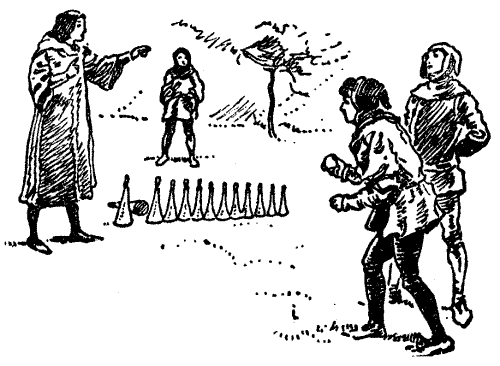
Nearly all of our most popular games are of very ancient origin, though in many cases they have been considerably developed and improved. Kayles—derived from the French word quilles—was a great favourite in the fourteenth century, and was undoubtedly the parent of our modern game of ninepins. Kayle-pins were not confined in those days to any particular number, and they were generally made of a conical shape and set up in a straight row.
At first they were knocked down by a club that was thrown at them from a distance, which at once suggests the origin of the pastime of "shying for cocoanuts" that is to-day so popular on Bank Holidays on Hampstead Heath and elsewhere. Then the players introduced balls, as an improvement on the club.
In the illustration we get a picture of some of our fourteenth-century ancestors playing at kayle-pins in this manner.
Now, I will introduce to my readers a new game of parlour kayle-pins, that can be played across the table without any preparation whatever. You simply place in a straight row thirteen dominoes, chess-pawns, draughtsmen, counters, coins, or beans—anything will do—all close together, and then remove the second one as shown in the picture.
It is assumed that the ancient players had become so expert that they could always knock down any single kayle-pin, or any two kayle-pins that stood close together. They therefore altered the game, and it was agreed that the player who knocked down the last pin was the winner.
Therefore, in playing our table-game, all you have to do is to knock down with your fingers, or take away, any single kayle-pin or two adjoining kayle-pins, playing alternately until one of the two players makes the last capture, and so wins. I think it will be found a fascinating little game, and I will show the secret of winning.
Remember that the second kayle-pin must be removed before you begin to play, and that if you knock down two at once those two must be close together, because in the real game the ball could not do more than this.
Read Answer
Next:
The Broken Chessboard
Previous:
The Frogs Who Would A-wooing Go
 Informational